How to choose between decorative, ornamental, and architectural metalwork
Decorative, ornamental, and architectural metalwork are related, but they do not always describe the same project need. Decorative metalwork is usually selected for visual enhancement, ornamental work often uses crafted patterns or traditional detailing, and architectural metalwork must coordinate closely with the building, site, structure, access, and surrounding finishes.
Key takeaways
Start with the purpose
Decide whether the metalwork is primarily adding visual detail, expressing a particular style, or performing an architectural function within the building.
Expect the categories to overlap
A railing can be architectural because it protects an edge, ornamental because it includes crafted patterns, and decorative because it contributes to the visual identity of the space.
Project conditions matter more than labels
Dimensions, exposure, structural requirements, surrounding materials, installation access, budget, and maintenance should guide the final fabrication strategy.
What is decorative metalwork?
Decorative metalwork is created mainly to improve visual character. It may include screens, wall panels, fireplace surrounds, divider panels, trim, brackets, address features, landscape accents, and contemporary patterned elements. The design can be simple or highly customized, but appearance is usually the main reason the feature is included.
Contemporary patterns
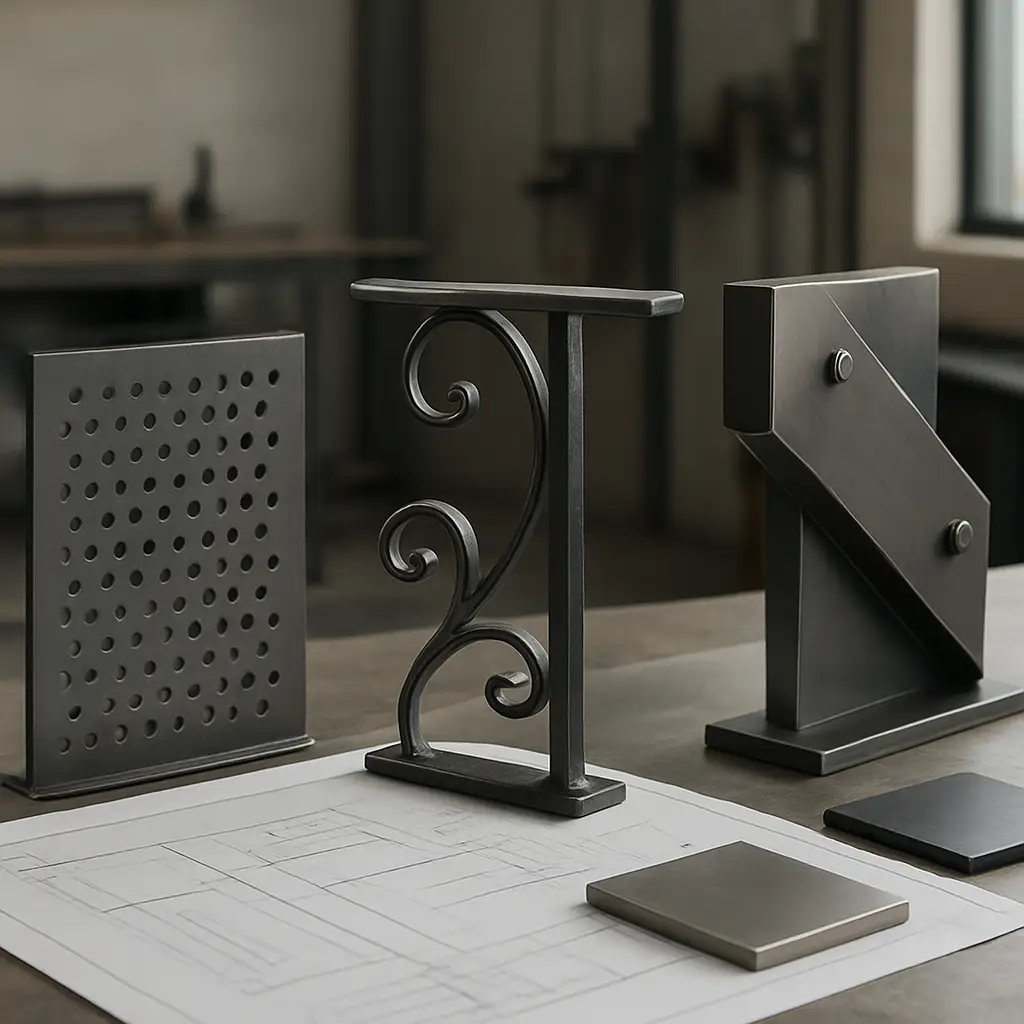
Geometric screens, perforated panels, linear dividers, and repeated cut patterns can add texture without relying on traditional scrollwork.
Interior focal elements
Fireplace surrounds, display frames, metal shelving details, and feature walls can introduce contrast beside wood, stone, glass, or plaster.
Exterior visual accents
Custom panels, address markers, planters, screens, and building details can strengthen an entry or exterior elevation.
Projects centered on modern screens, visual accents, or contemporary feature panels may fit best within custom decorative metal fabrication .
What is ornamental metalwork?
Ornamental metalwork usually refers to crafted detailing that gives the metal itself a strong visual identity. It is often associated with scrolls, curves, patterned pickets, forged-looking details, finials, decorative gate panels, traditional railings, and heritage-inspired features.
Traditional gates and fences
Repeated scrolls, decorative pickets, shaped tops, and crafted panels can give a property entrance a formal or established character.
Detailed stair railings
Ornamental infill and custom transitions can make a stair or balcony railing more expressive than a minimal straight-picket system.
Restoration-inspired elements
Custom fabrication can reproduce the visual language of an older building without relying entirely on standardized replacement components.
Projects involving crafted patterns, traditional details, or character-rich gates and railings may be better suited to ornamental metal fabrication .
What is architectural metalwork?
Architectural metalwork is designed as part of the building or site. It must coordinate with dimensions, structure, circulation, weatherproofing, code requirements, adjacent finishes, and installation conditions. Common examples include stairs, guards, handrails, canopies, entry systems, feature doors, screens, and building-integrated metal details.
Building-integrated function
The feature may protect an open edge, support circulation, shelter an entrance, control access, or form part of the exterior building envelope.
Detailed coordination
Architectural metalwork often requires shop drawings, verified dimensions, structural input, finish approvals, and clear connections to surrounding construction.
Visible design responsibility
Because these elements are often permanent and highly visible, proportions, joints, welds, fasteners, transitions, and finishes must be treated intentionally.
Stairs, railings, canopies, doors, and other building-connected features generally require the deeper planning provided through architectural metal fabrication .
Decorative vs ornamental vs architectural metalwork
Decorative
Primarily chosen to add visual interest, texture, contrast, or a customized design feature.
- Modern screens and panels
- Fireplace surrounds
- Wall and ceiling accents
- Address and landscape features
- Contemporary dividers
Ornamental
Primarily chosen for crafted visual detail, patterned expression, or traditional and heritage-inspired character.
- Scrollwork and curved forms
- Patterned railing infill
- Decorative gates
- Finials and shaped pickets
- Traditional metal details
Architectural
Designed to perform a building-related function while meeting project-specific dimensional, structural, and coordination requirements.
- Stairs and landings
- Guards and handrails
- Canopies and awnings
- Feature doors
- Building-integrated screens
Can one project use all three approaches?
Yes. The categories describe different aspects of the work rather than strict boundaries. A custom metal gate can be architectural because it controls access, ornamental because it includes crafted patterns, and decorative because it contributes strongly to the property’s visual identity.
Architectural stair with decorative screening
The stair provides circulation, while a custom screen beside it adds texture, privacy, or visual separation.
Functional railing with ornamental infill
The guard performs a safety function, while the infill pattern introduces traditional or custom-crafted detailing.
Entry canopy with decorative fascia
The canopy protects the entrance, while custom fascia panels or support details strengthen the building’s visual character.
How to choose the right type of custom metalwork
Define what the feature must do
Identify whether the metalwork controls access, protects an edge, provides shelter, divides a space, adds privacy, or serves mainly as a visual feature.
Choose the design language
Decide whether the project calls for minimal contemporary lines, crafted traditional details, expressive patterns, or a restrained building-integrated solution.
Review practical requirements
Confirm dimensions, structural needs, exterior exposure, surrounding materials, access, fabrication complexity, budget, and maintenance expectations.
Which approach fits different project types?
Modern residential interiors
Architectural stairs and railings may be combined with decorative screens, fireplace surrounds, or metal accents that coordinate with wood, concrete, glass, and stone.
Traditional residential properties
Ornamental gates, railings, fences, and entry details can support a more established architectural style when the pattern and scale match the home.
Commercial entries
Architectural canopies, railings, doors, and access features may be paired with decorative branding panels or screens.
Luxury custom homes
All three approaches may be combined across feature stairs, gates, doors, fireplace surrounds, balcony guards, and bespoke interior details.
Renovations
Existing dimensions, finished surfaces, structural limitations, and access conditions may determine whether a design can be installed as originally imagined.
New construction
Early coordination provides more opportunity to establish attachment points, structural backing, finish transitions, and installation sequencing.
Pacific Northwest project realities
Metalwork across Washington and Oregon must be selected for the actual site. A protected interior feature in Seattle or Portland faces different conditions from an exposed gate near the coast or a canopy subject to snow and freeze-thaw conditions east of the Cascades.
Local conditions to consider
- Persistent rain and moisture exposure in west-side locations
- Leaves, needles, moss, and organic debris near landscaped properties
- Coastal air and more demanding corrosion conditions in some locations
- Snow, ice, and wider temperature changes in higher-elevation and inland areas
- Renovation conditions in older Seattle, Tacoma, Portland, and Eugene properties
- Tight access and occupied-building coordination in urban projects
Does the metal type determine the category?
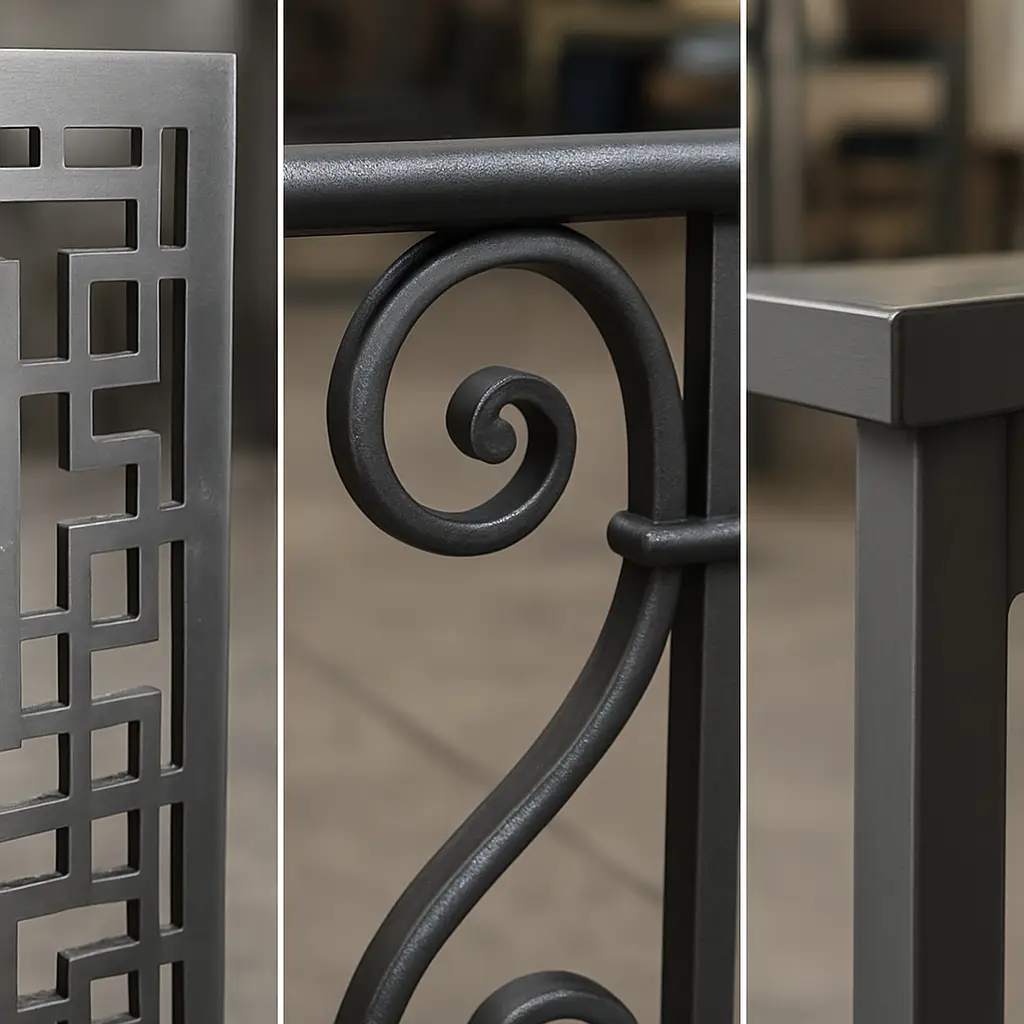
No. Steel, stainless steel, and aluminum can all be used for decorative, ornamental, or architectural work. The category depends more on the project purpose, design, fabrication process, and connection to the building than on the material alone.
Steel
Steel is widely used for stairs, railings, gates, screens, canopies, doors, and both contemporary and traditional fabricated details.
Stainless steel
Stainless steel may suit exposed details, clean interior applications, and projects where corrosion resistance or a visible metallic finish is important.
Aluminum
Aluminum can be useful where lower weight, corrosion resistance, or formed and patterned panels are project priorities.
Finish selection should follow the environment
Finish decisions should account for exposure, desired appearance, surrounding materials, cleaning access, expected wear, and realistic maintenance. A finish that works well on an interior screen may not be appropriate for a fully exposed gate or canopy.
Powder-coated finishes
Powder coating can provide a consistent color and texture, but preparation, edge coverage, drainage, and future inspection still matter.
Visible metallic finishes
Brushed, polished, blackened, or patinated appearances can create strong visual character, but samples should be reviewed under realistic lighting.
Exterior maintenance
Exterior elements should be periodically checked for coating damage, trapped debris, loose hardware, staining, or conditions that could affect long-term performance.
Which type of metalwork costs more?
None of the three categories is automatically more expensive. Pricing depends on size, geometry, material, repetition, engineering, finish, pattern complexity, site measurement, installation access, and the amount of hand fitting or custom detailing required.
Repetition can improve efficiency
Repeated pickets, panels, or patterns may become more efficient once the first component and fabrication setup are approved.
Complex interfaces add coordination
Stairs, canopies, doors, and building-connected screens often require more drawing, structural, and installation coordination.
Handcrafted detail affects labor
Curves, compound shapes, fitted transitions, and highly detailed ornamental patterns may require more fabrication time than simple repeated profiles.
Information to share with a metal fabricator
Project location
Provide the Washington or Oregon location and explain whether the feature will be indoors, protected, or fully exposed.
Photos and drawings
Share wide photographs, close details, architectural drawings, rough dimensions, and images showing nearby materials.
Functional requirements
Explain whether the feature must provide safety, access control, weather protection, privacy, separation, or primarily visual enhancement.
Design references
Include examples that show preferred patterns, profiles, transparency, proportions, finishes, and overall design style.
Construction stage
Identify which surfaces and structural conditions are complete and which measurements may still change.
Budget and schedule
Provide realistic expectations so the design direction can be evaluated against fabrication complexity and project timing.
Decorative, ornamental, and architectural metalwork FAQs
What is the difference between decorative and ornamental metalwork?
Decorative metalwork is a broad category focused on visual enhancement. Ornamental metalwork often refers more specifically to crafted patterns, scrolls, shaped pickets, and traditional or character-rich details.
What makes metalwork architectural?
Metalwork is generally considered architectural when it is designed as part of the building or site and must coordinate with dimensions, structure, circulation, weather exposure, surrounding materials, or code requirements.
Can a railing be both ornamental and architectural?
Yes. A railing can perform an architectural safety function while also using ornamental infill, crafted patterns, or decorative transitions.
Is ornamental metalwork only suitable for traditional homes?
No. Ornamental detailing can also be simplified or reinterpreted for contemporary projects. The scale, pattern, and finish determine whether it feels traditional or modern.
Which type is best for a custom metal screen?
A screen may be decorative when its main purpose is visual, architectural when it controls privacy, circulation, or sun exposure, and ornamental when the pattern itself is highly crafted.
Does architectural metalwork require engineering?
Some projects do. Structural stairs, guards, canopies, and other load-bearing or safety-related elements may require engineering or professional review depending on the design and jurisdiction.
Can decorative metalwork be installed outdoors?
Yes, but the material, coating, drainage, fasteners, and maintenance plan should be selected for the actual level of exterior exposure.
What is the best first step?
Share the project location, photos, dimensions, functional goal, design references, preferred finish, and current construction stage so the fabricator can identify the most suitable approach.
Need project-specific input?
Share what you are planning, where the project is located, and what stage you are in. We will help determine whether the work is primarily decorative, ornamental, architectural, or a combination of all three.
Share your project type, location, drawings, photos, design references, and current construction stage.